
 YouTube
 Spotify
 Apple Podcasts
 Pocket Casts
 Amazon Music
 Castbox
 iHeart
 Overcast
 Goodpods
 More Options
Transcript
Smiti: Welcome to Curiosity Meets the Past, a podcast for curious minds who love learning about the past. I’m Dr. Smiti Nathan, and I’m an archaeologist and your host.
In this episode, I’m speaking with Michelle Franklin, who’s a scholar of interdisciplinary studies, an author, and a podcaster.
One of Michelle’s areas of deep interest is linguistics. She’s explored this through formal study and many research rabbit holes driven by her own curiosity.
Together, we dig into the stories behind words you might have heard of, and some you probably haven’t.
Michelle Franklin (Legends and Lectures): A word that has a really interesting origin that I like to point out a lot is the word púca. So, for those who don’t know, a púca is, creature, or a shapeshifter, spirit, in Irish folklore. But the word púca itself is not Irish. And actually it can’t be because it starts with a p. And p words in the Irish language are foreign.
Because Irish, it’s what’s called a “Q-Celtic” language. And so, like Gaelic, Manx, Gaelic, they’re all the Q-Celtic languages. And P-Celtic languages are Welsh, Cornish, Breton. And it has to do with the sound change, that’s why they’re called P and Q.
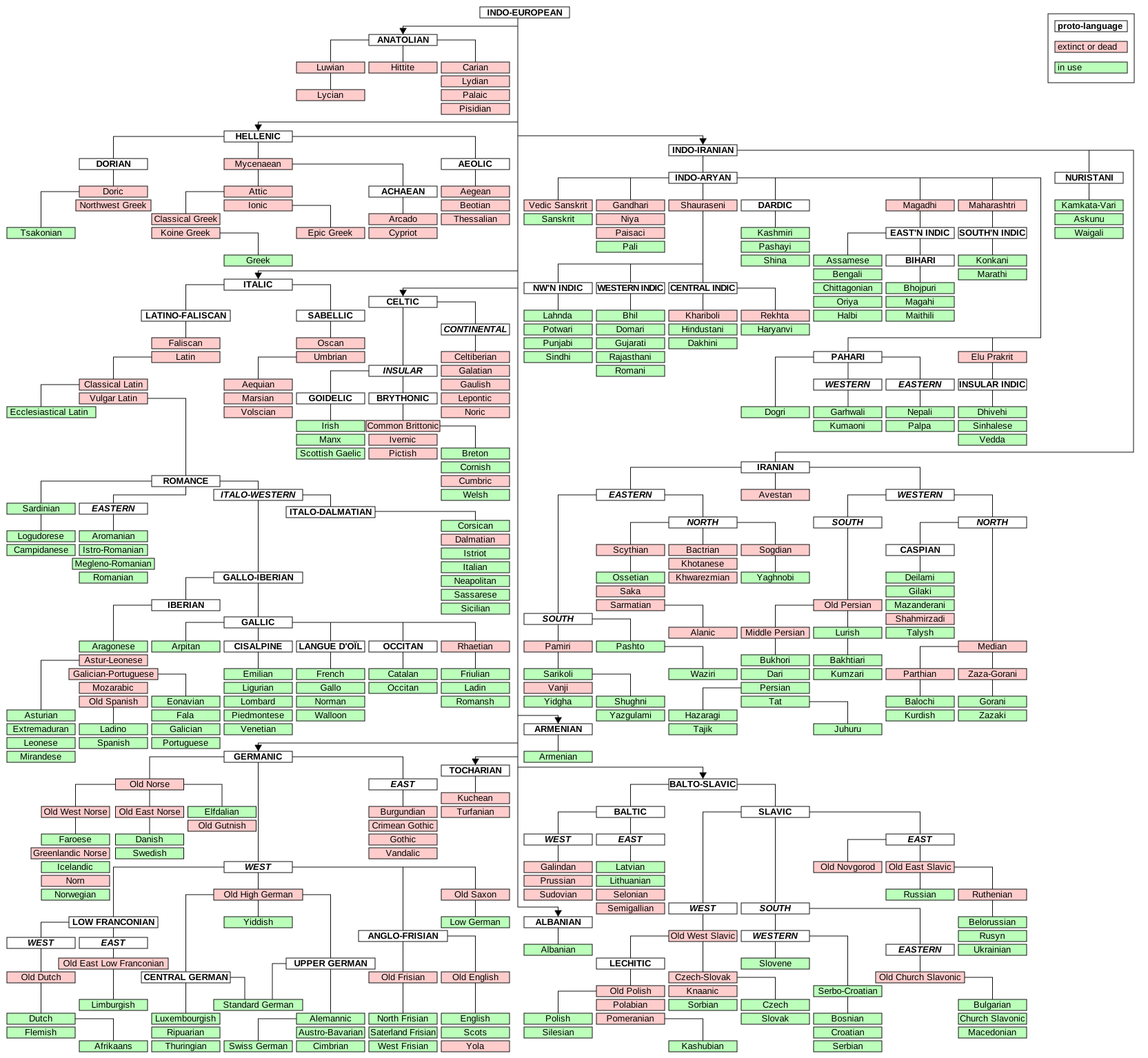
But “púca” is related to the Old English “puck,” which I think many people know from Shakespeare. And it probably came to Ireland via the cognate and Old Norse, “púki,” like a devil or a spirit. It has nothing to do with, like, the sweetheart named “pookie.” That’s completely different. But this word is Germanic and whether there’s another P-Celtic source, we, we really don’t know. But it’s also related to the word, probably related to the word, “spooky” via the Germanic root. So púca, púki, spooky. Again, to mean spirit, devil, that kind of thing. So, a lot of people mistakenly think that, that even though it’s an Irish folklore spirit, the word comes from the Germanic instead.
Smiti: Fascinating. Thank you for that. So, in your opinion, what makes something a word?
Michelle Franklin (Legends and Lectures): This, this along with: What’s a dialect? What’s an accent? The, these are always, you know, the a hundred dollars questions. So, for my money. If two people are speaking a given language, obviously it doesn’t have to be English are using a specific word, and each speaker understands that word, whatever it is, within the context, and it has a meaning that both people understand it, is technically a word. Whether we like it or not. It’s the same thing goes for pronunciations. Because people make bones about pronunciations. If two people use the same pronunciation and that pronunciation starts to spread from their region outward and it’s, it’s an accepted pronunciation again, whether we like it or not.
You’ll hear this a lot when you know, you hear things like nuclear, you just, people go, that’s not a word. And you go, well. It’s now being used in England. It obviously, it started in the States and now it’s being used in places like England. So, it’s now an accepted pronunciation. You’ll often hear people say, that’s not in the dictionary. And I always challenge these people by saying, well, some of the words you use are simply not there. They’re not in the OED, but you speak them and people understand them. In the end, whether really something is a word, it really is about communication and mutual intelligibility. That’s what makes it work. In my, book. I know everybody’s gonna argue with me on the internet.
I can already feel the comments coming. But that is, that is what it is. Whether we like it or not. So, even the words we hate. It’s what it is.
Smiti: So, when we’re thinking of words, I think sometimes our emotions come into play when we’re thinking about like what counts and what doesn’t.
And I really loved your definition of what makes a word. But I’m also curious, are there words that even though you recognize them as a word, you don’t particularly like?
Michelle Franklin (Legends and Lectures): I don’t mind this word, but you always see the memes about “moist” and how people just don’t like that word. I’m fine with it actually. I don’t mind it at all. There are words that I dislike. Just because of how they function, not that they’re words. So for example, the classic is “irregardless.” I absolutely hate this. But not because people use it, but because the word regardless is already there and it already means what people want it to mean. And I think it, it became Irregardless because people were confusing it with irrespective. Which again means something similar to regardless, you see? Irrespective of the fact, regardless of the fact. And so I think that putting the two together, the problem is that the, the prefix “ir” immediately negates the regardless part, linguistically speaking. And so that’s why it bothers me, like regardless, already does what you wanted to do. Just use just. And by saying irregardless, it technically the meaning of the word should be the opposite of what regardless means, but people are using it like this. What are, what are some words that you really don’t like?
Smiti: That’s a great question. You know, for me personally, I think because I am a parent to a 6-year-old who is really trying to get a grasp of language and I see him playing with different words and their meanings, and also being in kindergarten and interacting with other kids, I, I just don’t like words that are mean.
That are hurtful. So it’s not so much that I have an issue with a particular word per se, but how a certain word could just, you know, hurt someone with its use. So basically anything that’s a bit mean, I, I really don’t like. But I think that comes into another good question in terms of, t he meanings of words are changing all the time. And can you think of a word that has actually shaped how we think about people or culture or community?
Michelle Franklin (Legends and Lectures): There are unfortunately pejorative ones, which we’re not gonna get into. But we make up words to label our own communities all the time. The word “nerd” is a good one. I’m very much a nerd. When I say I’m a nerd, you immediately associate me with glasses, books, nerdy things, maybe games, manga, comics, that kind of thing. But again, that’s a word that obviously was made up by somebody else, but then it was claimed by a specific community. And now we wear that word proudly and we say, we’re nerds. We go to Comic-Con. We we do this, we, we love, we love Marvel movies, all that kind of thing. So it, it has that, association with it.
It’s possible that Dr. Seuss made up that word or that that word was swimming around, but he’s the first person who recorded that word, word in text. It was derogatory until the 1980s. And then like I said, people started self-identifying in order to show people that they, that they were nerdy.
And so you make that click with that language, with that specific word. But uh, as well sign languages. Sign languages shape their communities specifically.
And there isn’t just one sign language. There are many of them that give people who are hearing impaired the ability to communicate in ways that don’t require writing, and that also exclude people who are not part of that community.
Smiti: Got it. So, can you walk us through an example of an English word that has gone through a surprising transformation?
Michelle Franklin (Legends and Lectures): There are a lot of them. But let’s, take a second to talk about semantic transformations. Semantics is a very detailed science, but semantics is related to etymologies, the study of word meanings and, and how the meanings of words get used and changed over time. But the word “like” probably has the most drastic and surprising transformation. Do you know what this word originally meant?
Smiti: No, please tell me.
Michelle Franklin (Legends and Lectures): So originally, so, “like” comes from the Germanic root for a “body” or a “form.” And in Old English it came to mean something “similar to” or, and then the colloquial “like to,” as in almost, or nearly. As in like, I, I like to do something or I, I like to do this is 17th century. And then the short for, “to come near to,” or some saying that something was likely, came after that. And then “to feel like to do something,” like, I feel like pizza tonight. That came in the 1800s, 1863. And meaning “such as”, or as in “a girl like you” was in 1886. I think that’s the first attested use. And then it became a filler. Going like really fast, something like that, or, as they use it in England at the end of sentence. And then there was the emphatic in, in 1950. And now we use it as a quotative. I was like, he was like, she was like, right. And what does it even mean anymore? You don’t even know. So, it’s gone through a really incredible transformation for something that used to mean body or to mean something. And then again, something similar to self or similar to. It meaning something that that is said or like I said, a quotative. Why this got picked as a filler word or a quotative? I can’t tell you.
Smiti: You know, and as you were speaking, it got me thinking about slang. And slang often gets dismissed, but I think it’s one of the most vibrant aspects of language, and especially how language evolves. And what do you think slang reveals about how language actually works?
Michelle Franklin (Legends and Lectures):
Well, slang is part of language. That is it. So, if anybody says slang’s not real words. I disagree, and I am, not wrong on this. It’s a necessary feature of how the evolution of, of language evolves. And every language has slang. Every generation has their own slang. Slang enriches language. People often say, oh, slang is not real, because many slang words don’t last. But I, there are many words that are also, also become obsolete in that people just don’t use anymore. Slang words that have become obsolete very quickly, let’s say something like “yolo”. Whereas if you say that to kids nowadays, they, they don’t know what it is. It was a dumb slang to begin with, and I, you know, everybody only uses it ironically. But a very specific part of the English speaking world will know what that is. One of my favorite dictionaries is the “Vulgar Dictionary” of 1811, where it’s all horrible words and slang words that people used in 1811. And some of them lasted and many of them didn’t.
But they’re still brilliant and they’re lovely. Slang is often categorized as a fad, right? Until it sticks. “Sociolects,” which are non-standard and non regional dialects that are adopted for, from certain communities, create slang words amongst them in order to show that you are part of that specific culture.
But very specifically, if you want a recent example, take LGBTQ sociolects. And this is part of a study called Lavender Linguistics of how LGBTQ folks speak to each other and how we now use their words.
So, “spilling the tea” is a big one. So that slang in that sociolect are now part of our speech.
Smiti: Thank you for that. And it just got me thinking that, you know, we’ve been talking about words, but then you also mentioned phrases. And phrases also shift in meaning over time. Is there a phrase that you love that has a totally unexpected origin?
Michelle Franklin (Legends and Lectures): People just make up stuff on the internet. Like, did you know where this phrase really came from? And you’ll hear that all the time and 99% of the time, it’s not true. The one, one of them that is true though is “curiosity killed the cat”. It was first written down by Ben Johnson as “care will kill the cat“. Why this changed to “curiosity killed the cat”? I can’t answer that question. I don’t think we know. The modern variation was found in an Irish newspaper in 1868, and we have no idea why this changed. “Begging the question” has also changed. It used to mean something completely different. The phrase was originally used by Aristotle. And historically “begging the question” referred to a fault in an argument. And now we use it to mean: “Well, that begs the question”. And then you ask another question. But that’s not what it originally meant.
Smiti: Thank you for that. Now, you looked at words across different languages. What stands out when it comes to how English forms and adopts words versus other languages?
Michelle Franklin (Legends and Lectures): This is a tough one because every language adopts words. It’s just how it is. That’s the function of language. Sometimes things are adopted in, in a very interesting way, so I’ll give you an example. Word adoptions obviously happen all the time, but borrowings and loanwords, English is really good at this. But it’s also really good at gifting it them to other languages, letting other languages play with English, and then readopting, o r re-borrowing, or pseudo adopt, borrowing that word back into English. So I’ll give you a few examples. Karaoke. Or what Japanese would say, karaoke, right? That word comes from karaoke, “empty orchestra’. We gave it to them. As as “orchestra”, they made karaoke “empty orchestra” and then they gave that word back to English speakers as “karaoke”. Japanese loves to do something called “Wasei-eigo“, which are Japanese words that are made from English words that just kind of make no sense in English context.
So, for example, the one I like to give is the word “dead ball“. Do you know what that means?
Smiti: I’ve heard it, but I’m totally drawing a blank, so let’s go with no.
Michelle Franklin (Legends and Lectures): “Dead ball” is actually a foul in what we would call a foul in baseball.
But even though those two words, “dead ball” are English words, they make no sense in an English context. So, they took that from us. They decided to reconfigure that in a way that made sense to them. And so, now they have this wonderful word, “dead ball”, which if you would, when is explained to us, go, yeah, that makes so much, that makes so much sense. So we, borrowings from English back happen all the time. A really good one. Here’s a really good one: “pajama”. Do you know where the word pajama came from?
Smiti: No.
Michelle Franklin (Legends and Lectures): Pajama came from originally came from Farsi or from Persian, which was borrowed into Hindi, then borrowed into English as, as pajama as we use it, which was then borrowed into French. Which was then reborrowed back into modern Persian as, as pajama as a different spelling. So, words get banded about all the time. I guess English is so good at uptaking words and, re-gifting them to others that English is not just the best adopter, it’s not. There are many other languages that do the same thing. But it’s probably because of its global standing as a language nowadays, that might change in the future, English is really good at gifting and re-gifting words to other languages,
Smiti: I love this idea of a gift and re-gifting,
Michelle Franklin (Legends and Lectures): Whether they want it or not.
Smiti: So, what do you hope people take away from thinking more deeply about where words come from?
Michelle Franklin (Legends and Lectures): That there’s really no one way or wrong way to do language. I think people get really hung up about that. The whole purpose is communication. And if people are effectively communicating and there’s mutual intelligibility, then words can’t really be wrong, even though there are words we all hate. But words are not wrong. There is also as well that there’s no one English. There’s also no one Spanish. There’s also no one French. And people who try to police languages and say, your French is not real French, or your English is not real English. That’s not how language works. And especially if you, if you speak a brand of English that say like Singlish, Singaporean English, they have their own specific phrases, their own specific words. And that is a language and they have their own words and we should respect that.
Things change. Spellings change. Pronunciations change. That is just the, the function of language over time. Nothing is static, ever. And even though certain languages change, lets say not as quickly as others, your language is going to change in fifty, a hundred years. Your language may even die out.
Your language may be adopted by another country. Because of the internet and the speed at which information travels nowadays, language is globalizing. You have people who are learning languages that they would otherwise never have had contact with. Regionalisms are now becoming globalisms. For example, the example I like to give is the word “y’all”. “Y’all” was a very specific Southern American thing. And it became a globalization. Now you can hear people saying “y’all” in Ireland, maybe ironically, but, but I’ve heard Irish people saying the word “y’all”, which was very interesting to me. We’re getting more glottal stops as well in English, from the UK and Australia. More “bottle D’s” from Australia.
So, things like “butter,” “mountain.” The way, the way that we’re pronouncing things. “Mirror” becoming “mirror.” So, our, our pronunciation in, in certain ways is changing. Like I said, LGBTQ speech is now becoming mainstream. Things like “slay” or “its giving.” I just hope that people enjoy these changes.
I hope people find them interesting and fascinating, and I hope that they just enjoy the flow and the movement of language more and become more accepting and more adventurous. With regard to maybe the words they use. Or, more accepting of how other people use their language.
Smiti: One of the biggest takeaways from this conversation is that words aren’t fixed.
They evolve, get reimagined, and when we get curious, we can uncover stories from the past that reflect much more than just meaning.
If you’d like to learn more about Michelle’s work, you can check her out on YouTube, TikTok, and BlueSky, and you can find her podcast Legends and Lectures anywhere you like to listen to your podcasts.
You will find those links in the show notes along with a link to a full transcript of this episode.
And if you’re curious to hear Michelle’s word related book recommendations along with a few fun facts that didn’t make it into the episode, she shares that in a Patreon exclusive segment. Our Patreon is free to join and gives you access to all of our bonus content. Now, if you’re able to support the podcast monetarily, we’d of course appreciate that too.
Thanks so much for listening and cultivating your curiosity with us. We’ll see you soon.
Credits
Michelle Franklin: Guest
Noor Hanania: Theme Music Creator
Laura Riveiro: Podcast Cover Art Creator
Brooke Norton: Production Support
Smiti Nathan: Host, Video Editor
Patreon Supporters
Thank you to our paid Patreon members for supporting the creation of this episode:
Nancy Fulton, James D., Giancarlo Annese, Thomas Martin
Leave a Reply